Understanding how to calculate battery charging time manually is crucial for optimizing the performance of your devices. Expert David Johnson, an electrical engineer with over a decade of experience, once stated, "Knowing how to accurately gauge charging time can save both battery life and frustration." This statement highlights the significance of mastering this skill.
Calculating charging time can seem daunting. However, with the right formula and some practice, it becomes manageable. You can use the battery's capacity (in ampere-hours) and your charger’s output (in amps) to gauge how long it will take to charge fully. The process may involve some trial and error. Different devices and batteries can present unique challenges which might require adjustment.
Ultimately, having a solid grasp of how to calculate battery charging time manually empowers users to make informed decisions. Devoting time to learning this skill can lead to greater efficiency and prolong the lifespan of your devices. It’s essential to keep practicing and questioning your methods to improve accuracy and reliability.
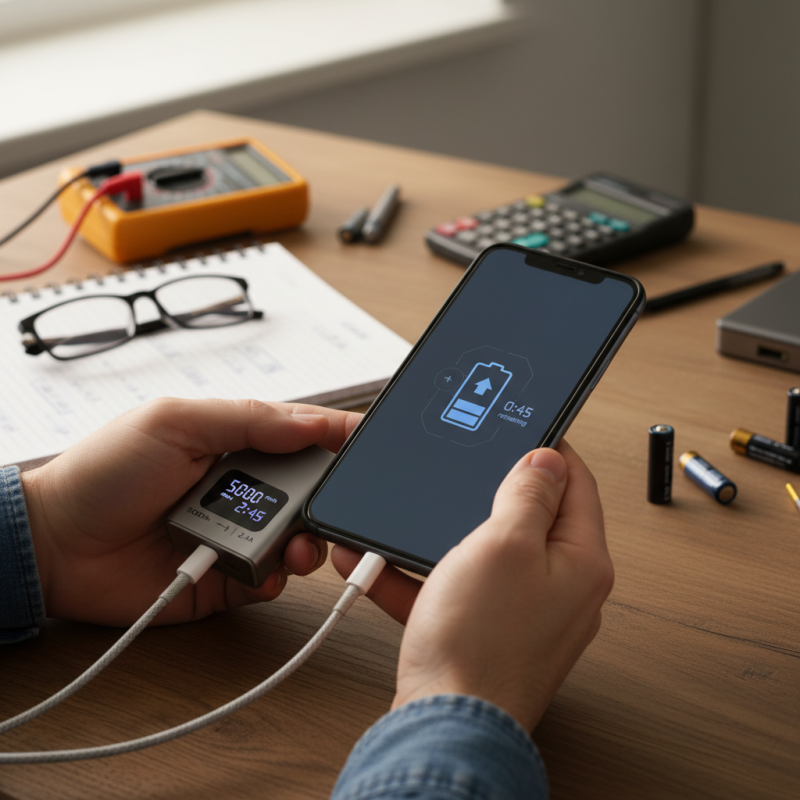
Understanding battery basics is crucial for effective charging. A typical lithium-ion battery operates at a voltage of 3.7V and has a lifecycle of around 500-1000 charge cycles. This means its capacity gradually diminishes over time. Awareness of these figures helps in determining the best charging practices.
When charging, the charging speed depends on the battery capacity and charger output. For instance, a 2000mAh battery would take around five hours to charge with a 500mA charger. This calculation, however, doesn’t account for inefficiencies, which can cause real charging times to rise significantly.
Charging temperatures also impact battery life and performance. Ideally, batteries should be charged at room temperature, around 20°C to 25°C. Higher temperatures can lead to chemical breakdown. A study reported that charging a battery at higher temperatures could reduce its lifespan by up to 30%. Understanding these principles can help users make better charging choices.
Battery charging time can be influenced by several key factors. Understanding these factors helps users optimize their charging processes. One significant element is the battery's capacity, measured in milliamp hours (mAh). For instance, a battery with a capacity of 3000mAh will take longer to charge than a 1500mAh battery under identical conditions.
Another crucial factor is the charger’s output current, often rated in amps (A). Higher current ratings can reduce charging time. Research indicates that using a charger with a 2A output can cut the charging time of a standard smartphone battery by up to 50%. However, using an inappropriate charger might harm the battery’s lifespan or safety, raising questions about device performance.
Ambient temperature plays a vital role as well. Batteries charge more efficiently within a temperature range of 20°C to 25°C. Charging a battery in extreme heat or cold can hinder performance and prolong the process. Additionally, the age of the battery affects its charging efficiency. Older batteries may not hold charge as well, leading to longer charging times. These insights emphasize the complexity behind battery charging, urging users to reflect on their charging habits for better efficiency and battery health.
Calculating battery charging time is essential for effective energy management. To determine the time it takes to charge a battery, you need to know its capacity and the charging rate. The formula is simple: Charging Time (hours) = Battery Capacity (Ah) ÷ Charging Rate (A). This approach gives you a rough estimate, but it's important to note that real-world factors can affect this time.
Consider an electric vehicle battery with a capacity of 60 Ah, charged at a rate of 12 A. Following the formula, the charging time would be 5 hours. However, that's an ideal situation. In practice, energy loss can occur due to heat, the battery's age, and ambient conditions. These factors can increase the charging time significantly.
It's also crucial to understand battery chemistry. Different batteries have varied charging profiles. Lead-acid, lithium-ion, and nickel-metal hydride batteries each require specific practices for optimal charging. Ignoring these details can harm battery life. Observing the charging process regularly can help you spot potential issues early. After all, knowing how to calculate charging time is just one piece of the puzzle.
| Battery Capacity (Ah) | Charging Current (A) | Estimated Charging Time (hours) | Efficiency Factor (%) | Adjusted Charging Time (hours) |
|---|---|---|---|---|
| 50 | 10 | 5.0 | 80 | 6.25 |
| 75 | 15 | 5.0 | 85 | 5.88 |
| 100 | 20 | 5.0 | 90 | 5.56 |
| 150 | 30 | 5.0 | 75 | 6.67 |
| 200 | 40 | 5.0 | 70 | 7.14 |
Estimating battery charging time can be straightforward with a little knowledge. Begin by identifying the battery's capacity, usually measured in ampere-hours (Ah) or milliampere-hours (mAh). Next, determine the charger’s output current, often available in amperes (A). A simple calculation can help: divide the battery capacity by the charger output. This formula gives you a rough estimate of the charging duration.
For instance, if you have a 2000mAh battery and a 1A charger, the estimated charging time is about 2 hours. This method does not account for efficiency losses which can occur during charging. Factors like battery age and temperature may slow down the process. Also, batteries charge at different rates. Not all current gets converted to stored energy. It’s beneficial to monitor how long it takes your specific battery to reach full charge.
Remember, charging rates can vary. Some batteries take longer due to their chemistry or design. Familiarizing yourself with your battery's characteristics will provide a more accurate estimate. Keep track of your observations. Over time, this practice will enhance your understanding of charging behaviors, leading to better management of your devices. Reflect on these experiences, allowing for adjustments in future estimates.
When it comes to optimizing battery charging efficiency, several factors come into play. One key aspect is the temperature of both the battery and the environment. Batteries generally perform best in moderate temperatures. Extremely hot or cold conditions can hinder charging speed and overall capacity. Therefore, keeping your device in a climate-controlled space can lead to better results.
Another consideration is the charger you use. Not all chargers deliver the same power output. Using a charger with the right voltage and current rating can significantly enhance charging efficiency. However, using too much power can also be harmful. Many devices have built-in mechanisms to manage power intake, but it's always wise to consult the manufacturer's specifications for optimal performance.
In addition to choosing the right charger, consciously managing charging habits can improve battery lifespan. Avoid charging your device overnight or letting it deplete completely before recharging. Regular, shorter charging sessions can maintain optimal battery health. Small changes in charging behavior can lead to noticeable improvements over time. While you may not see immediate differences, persistent efforts will yield benefits.
: A lithium-ion battery usually lasts between 500 to 1000 charge cycles. Capacity decreases over time.
Higher charger output reduces charging time. For example, a 2A charger can speed up charging by up to 50%.
Battery capacity, measured in mAh, is essential. It's calculated by dividing the capacity by the charger output.
Ideal charging temperatures are between 20°C and 25°C. Extreme temperatures may harm performance and lifespan.
Tracking charging duration helps users understand their battery's habits. This knowledge supports better management in the future.
Older batteries may charge slower. Different battery chemistries affect how they store energy and charge.
Yes, efficiency losses may increase actual charging time. Factors like battery health also contribute to this.
Yes, reflecting on charging practices leads to better efficiency. Adjustments can enhance battery management.
Divide battery capacity (mAh) by charger output (A). This gives an estimated duration. Adjust for efficiency losses.
Consider checking the charger output, battery age, and charging environment. Ensure you are in optimal conditions.
The article "How to Calculate Battery Charging Time Manually Tips and Tricks" provides a comprehensive guide on understanding battery basics and the principles of charging. It highlights the key factors that affect charging time, such as battery capacity, charger output, and state of charge. Readers will discover the essential formula needed to calculate charging time accurately and follow a step-by-step guide to estimate duration effectively.
Additionally, the article offers valuable tips for optimizing battery charging efficiency, ensuring that users can maximize their battery life while minimizing charging time. By grasping how to calculate battery charging time manually, individuals can make informed decisions about their charging routines and better manage their devices.

NexBolt Charger